
Here beginners in particular can follow the development of a Japanese fan maple (Acer palmatum) throughout the year 2000.
The bonsai is repotted, pinched, prepared for an exhibition and finally discolored before shedding its leaves.
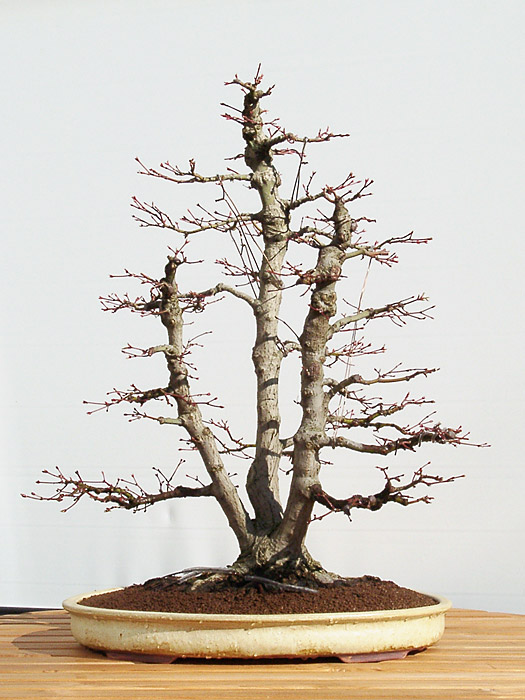
Three-stemmed fan maple 26.03.2000
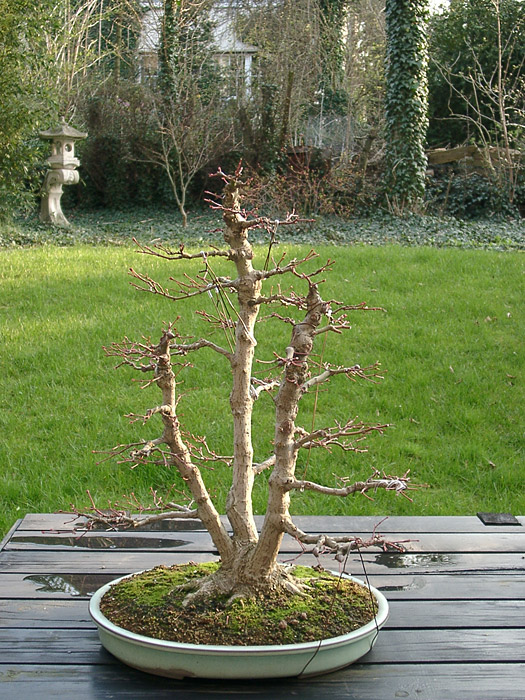
We want to accompany this maple over the coming growing season. It is already a very high-quality plant, but of course it still has a few flaws, but that’s what makes us happy:
We want to improve the quality so that one day we can call a “solitaire” our own.
The first step this year will be to repot the maple. We have had a bowl made especially for this tree.
Repotting 27.03.2000
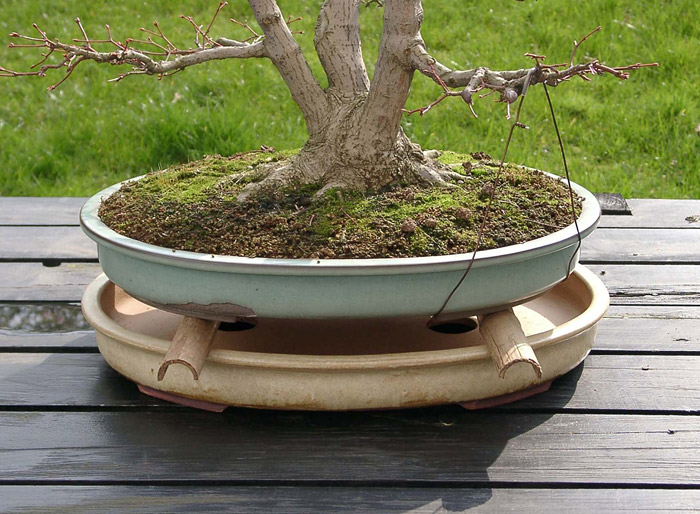
Why now? The plants are at their strongest shortly before bud break and the metabolism is running at full speed. This is the best way to cope with the “shock”. The timing has another advantage, especially for a vigorous maple: new shoots are slowed down a little for a short time. This means that the internodes, i.e. the gaps between the new leaves, are slightly shorter.
How do we choose the tray? Glazed trays go well with deciduous trees. These look somewhat “lighter” than unglazed ones (which are mainly used for conifers). The width of the bowl should be about two thirds of the height of the tree and the height of the bowl should be about the thickness of the trunk. However, these are only rules of thumb. The decisive factor is that the tree and the bowl should harmonize, like a picture and a picture frame.
Peter Krebs made this bowl. A special feature is the glaze, which harmonizes well with the color of the bark.

First, we need to work on the root ball. To do this, we first remove the old soil from the surface with a wooden stick, exposing the root base – nebari.
The next step is to carefully loosen the root ball from the outside inwards, then also from below, and remove the old soil. About a third of the soil can be removed from growing deciduous trees.
This is followed by root pruning. Dead roots are removed, weak roots are pruned slightly and strong roots are pruned vigorously. In this way, we balance out the root growth over the years so that one day we will have a beautiful nebari with evenly strong roots.
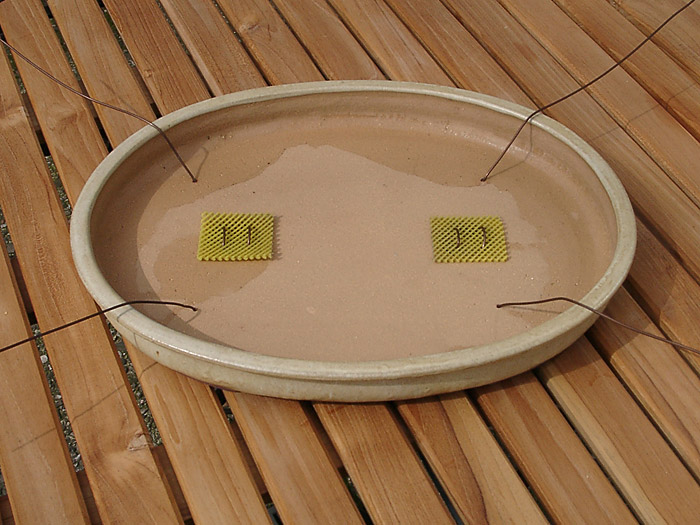
The tray is prepared. We attach netting in the large drainage holes so that the soil is not washed out. The small holes are intended for fastening wires (which cross under the tray). They serve to give the tree the necessary support in the tray during the initial period.
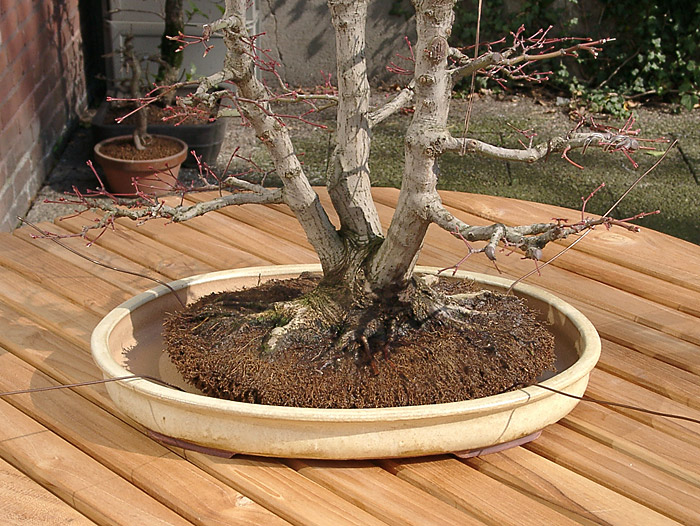
The new tray is about 1 cm shallower, so intensive work on the bale was urgently needed. As we can see, there is enough space for the roots.
Now the actual potting takes place: the tree is taken out again and the soil is filled in. We use pure Akadama (Japanese clay granules), sieved out in various thicknesses. The smallest grain size (<1 mm) is generally discarded.
The bottom layer, in this case 1-2 cm, consists of the coarsest grain size (> 4 mm). The tree is “fixed” firmly, but carefully, in the right place with slight twisting movements and secured with the wires. (Pad contacts of wire and surface roots!) This placement should not be directly in the middle, but slightly offset for aesthetic reasons. (We try to avoid symmetry in the design.)
The medium granules are now worked in with a wooden stick, not too coarsely, as coarse granules promote strong root and therefore also shoot growth. For “mature” bonsai, we want tender shoots for fine branching.
(You can find valuable information on various soils in our magazine).
Once the soil has been worked in, a very fine grit (no dust!) is applied for a decorative surface. Careful watering afterwards ensures that dust is flushed out (hinders drainage and aeration of the roots) and that all roots that may have suffered somewhat from repotting and “lay dry” are safely moistened.
In the following days, we place the tree in a sheltered position out of the wind and sun so that new fine hair roots can form before the plant loses too much water through evaporation. Only when the root ball dries slightly do we water again, ideally the buds will begin to open at this point. Then we start pinching…
11 days later … 07.04.2000
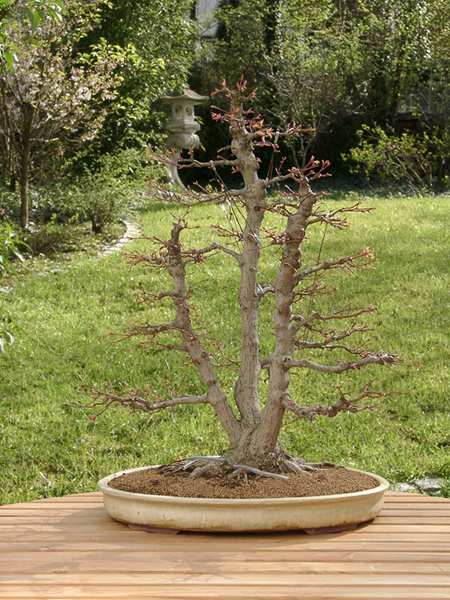
The root ball is drying out and the buds will soon sprout. Now it’s time to get the tree used to the sun again. We can water it and already have to pinch it. Let’s take a closer look at the branching.
Tweezing
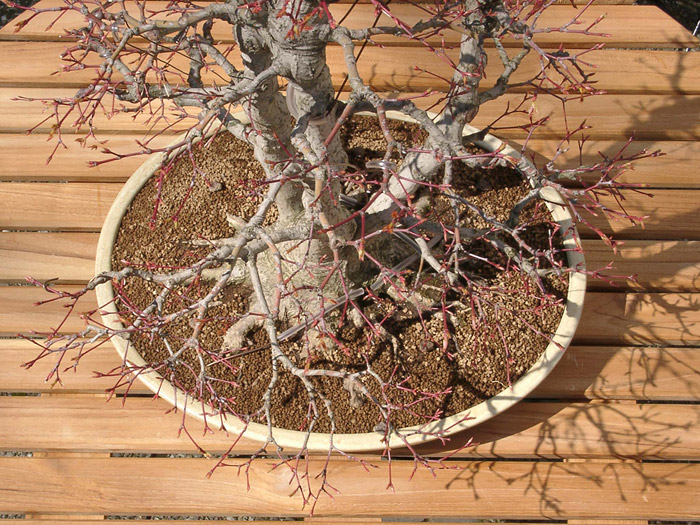
The buds thicken and open. The first leaflets will soon emerge and then the shoot growth can hardly be stopped.
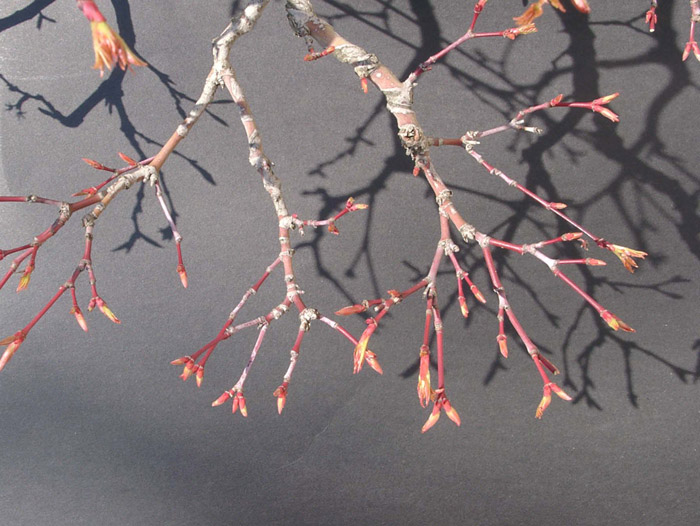
Why pinch? We want fine branching with short internodes (distances between the branches). For this reason, we should remove the second pair of leaves immediately after the first pair. The earlier, the shorter the resulting internode.
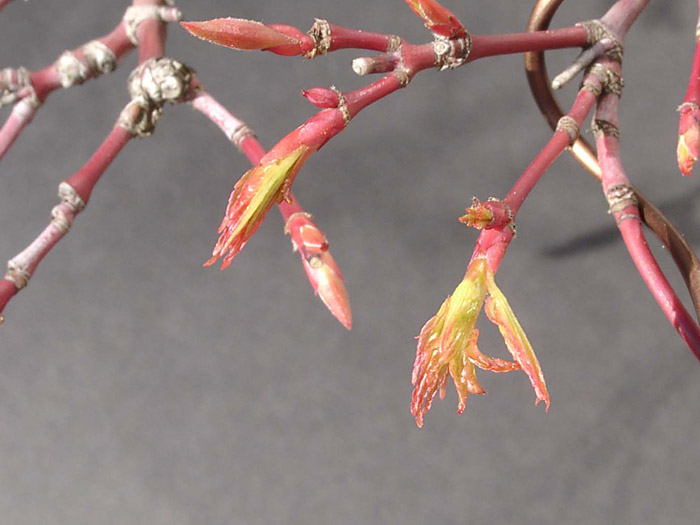
This shoot is “due”. The first two leaflets are unfolding. As soon as we can see the new central shoot with the second pair of leaves with the help of tweezers, it is time:
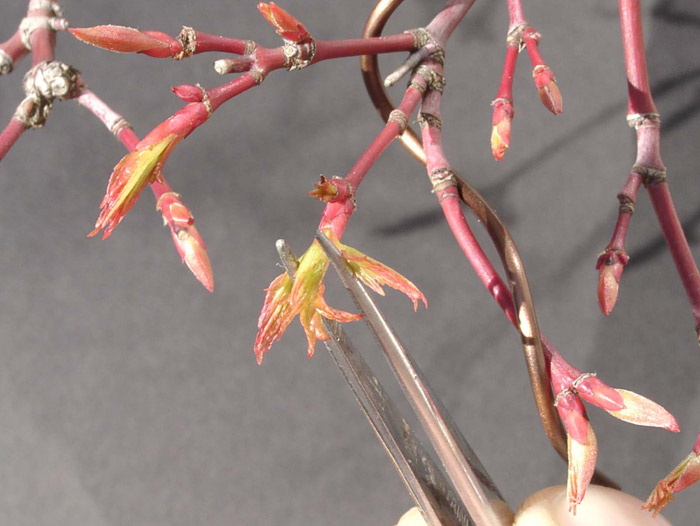
First, the first leaves are spread, …
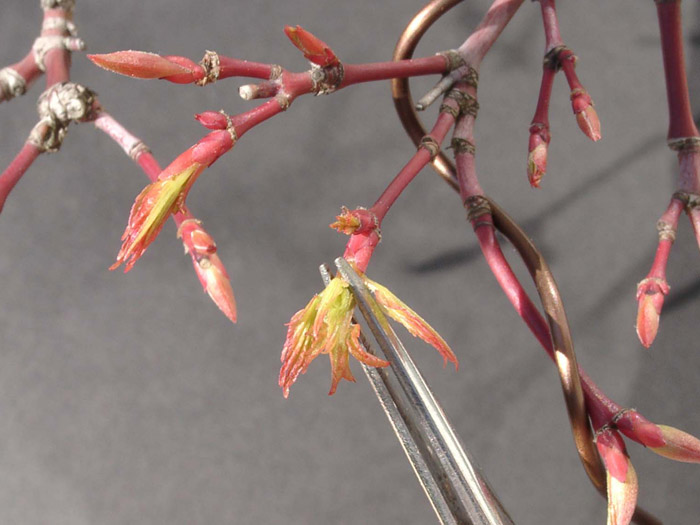
… we keep the central shoot as short as possible …

… and remove it.
The leaves can now unfold and the resulting shoot remains very short.
We repeat this process as often as possible during the spring weeks. If you are really meticulous, inspect your plant daily to pinch the “due” shoots. The reward is very fine branching, which cannot be achieved in any other way.
We can now also start to fertilize the tree very sparingly. If you are too generous now, you will hardly be able to control the vigor of a very vigorous maple. If you fertilize too little, you risk the health of the tree.
The leaf sheaths
Sometimes we have to be careful not to confuse the first leaves with the leaf sheaths. These can be very similar to leaves.
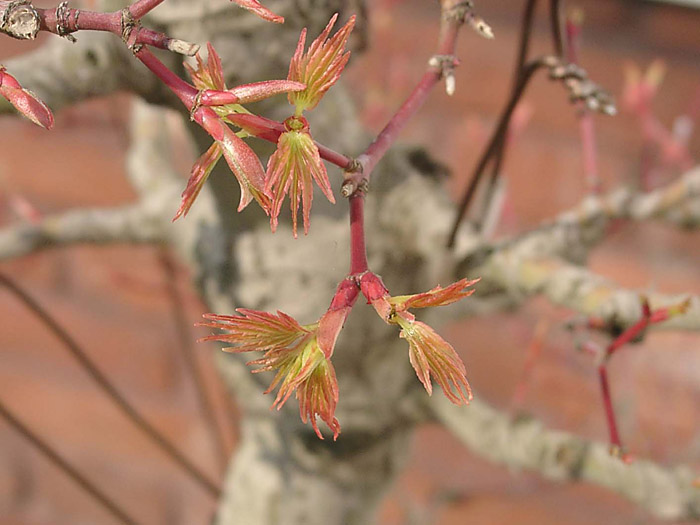
In this picture you can see a shoot (the one on the left) with a normal leaf sheath (on the right of the shoot) and a “false leaf” (covered by the second pair of leaves).
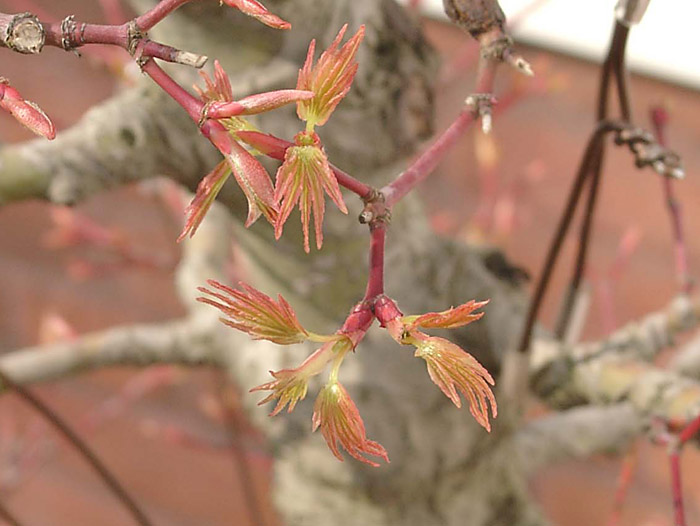
Here, after correct tweezing, the difference between a normal and an “abnormal” scabbard becomes clear. The normal one has already been removed, the “false leaf” is still between the first new leaves.
If we accidentally pinch the actual first leaves and leave only the leaf sheaths, there will be no length growth at all, but only two new buds at this point.
The spring budding 21.04.2000
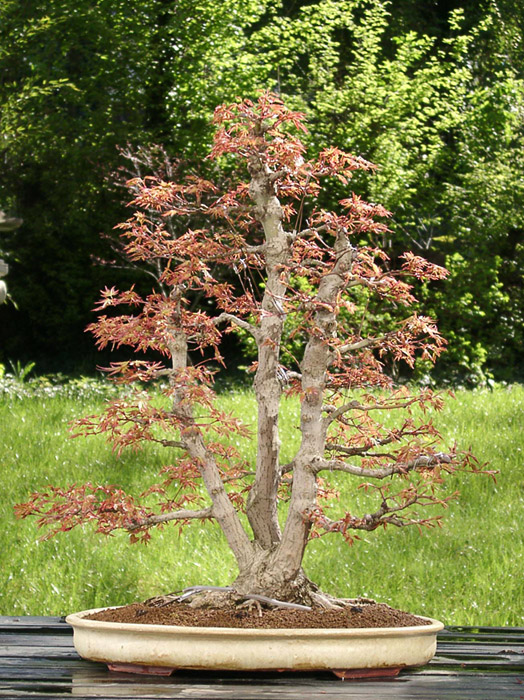
Budding is very vigorous in early summer temperatures. On some days it has to be pinched twice and you can almost watch it grow. A few days ago, we entered the tree for the Bonsaiclub Deutschland exhibition in Oldenburg (Whitsun, see Events). We are curious to see how it will be judged. There are certainly some flaws, but there is no doubt that the tree also has excellent qualities.
To present the bonsai in classic Japanese style, a matching table is required. We commissioned this from Uwe Herrmann. He is known for his excellent craftsmanship and aesthetics. We used the table on the cover of BONSAI ART 38 as a model.
Leaf cut? 13.05.2000

The entire foliage has now developed. We have pruned very carefully, fertilized very little and not watered too much, but the leaves are still very large. The decision to repot the tree with root pruning before the exhibition was not a very happy one. The forced root growth, even in the relatively fine granules, gave us the large leaves.
A leaf cut could now take place. However, there are only four weeks left until Oldenburg. During this time, the tree would sprout, but probably initially from all the dormant eyes and not just where we had left the leaf stalks. The overall picture would be more disheveled than worthy of display. So we are one experience richer!
Exhibition 14.06.2000
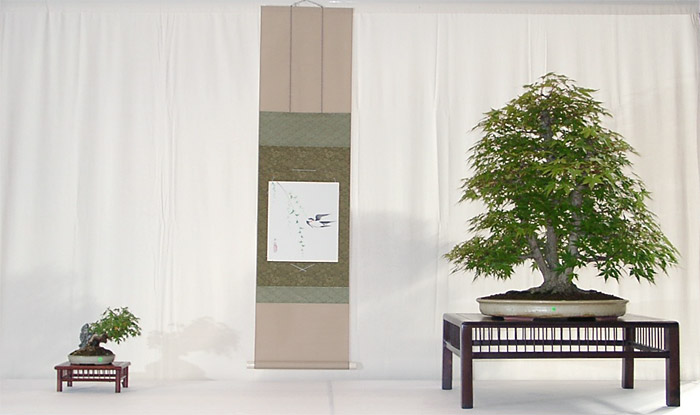
Last (Whitsun) weekend we put the tree on display. We received the table from Uwe Herrmann just in time. It was presented with an accent plant and a scroll picture. Unfortunately, the space available was very limited and there was no room for a complete presentation. So the neighboring bonsai, a five-fingered shrub (Potentilla), offered itself as an “accent plant”. We decided on a joint presentation and believe that both trees benefited.
The movement of the main tree is to the left, that of the accompanying plant to the right. The scroll painting – a swallow – captures the mood of the arrangement. The table is quite fine and thus comes close to the appearance of the maple.

The maple was one of around 80 trees approved for evaluation by the evaluation committee. (The Bonsai Club Germany has developed new evaluation criteria, which were used for the first time in Oldenburg).
A distinction was made between an aesthetic and an analytical part. In the first part, the tree received 5 points out of a possible 10 points for “balance, equilibrium, maturity” and 5 points for “suggestive effect, character, drama”. In the second part, 6 for “bonsai pot, placement”, 7 for “surface roots, soil surface, underplanting”, 4 each for “trunk”, “branch design”, “tree crown” and “leaves, needles, flowers, fruit”.
The “Remark” was: “Beautiful root base, bowl; even trunks, branches sit too low to the entire height, reconsider the front”.
We were delighted that we were even able to win a “Jury Prize” medal. Much more valuable, however, is the detailed evaluation, which has given us some ideas for further development. Hence our incentive: Don’t be put off by criteria and commissions! Take the opportunity to show your trees to other bonsai friends, you can only benefit!
Leaf cut!
28.06.2000
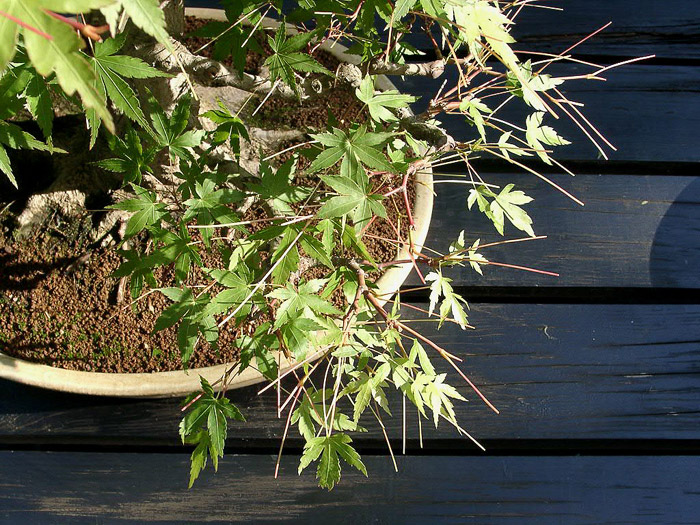
As already announced on 13.05. we have now decided to carry out a partial leaf cut. It took place on June 12, immediately after the exhibition in Oldenburg.
Leaves are removed during leaf pruning, but the leaf stalks are left in place. The tree experiences an “artificial fall” in which the stems are shed. This is followed by the sprouting of new, smaller leaves.
So what is the point of this procedure? Firstly, the proportions are improved and the small leaves are more decorative. Secondly, the branching is refined by the new, weaker shoots.
(Further information can be found in BONSAI ART issue 36 from page 8).
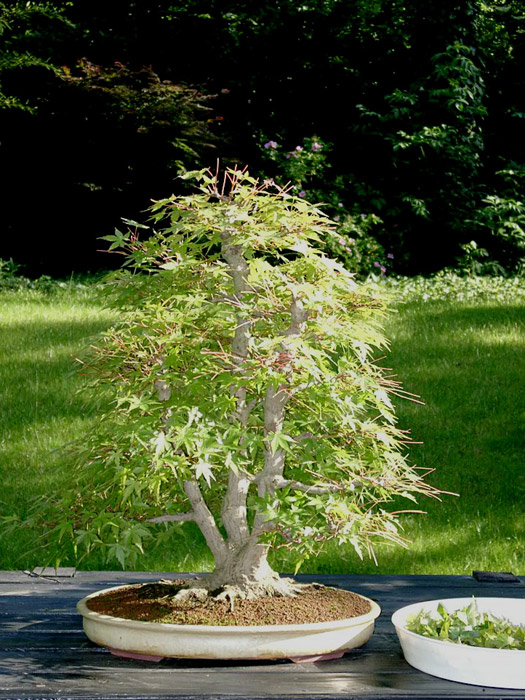
Leaf pruning also involves risks, as it places a strain on the bonsai. It should only be carried out on very strong, healthy specimens.
The picture on the left shows the maple after leaf pruning. Only the large leaves were removed, especially in the area of the right trunk and the tip, where finer branching is also desired.
We are curious to see when the new leaves will appear.
26.07.2000
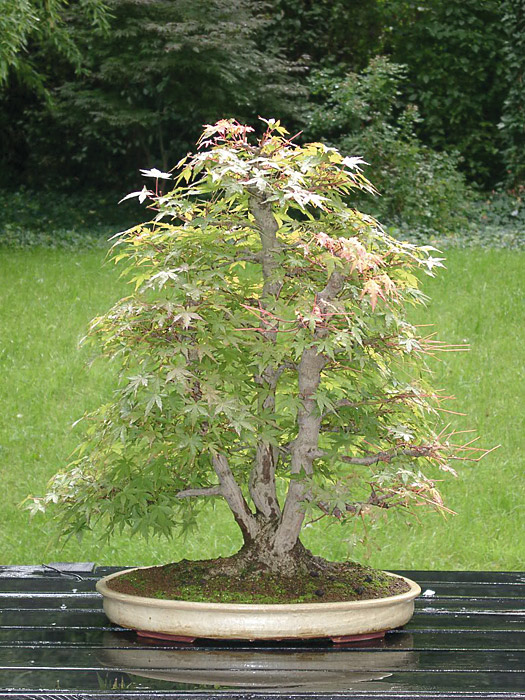
Very little has happened in the past few weeks. Most of the leaf stalks have fallen off. There are a few new leaves at the top of the main stem and the right stem, most of which have emerged between the old shoots.
Unfortunately, the weather wasn’t very good, so it wasn’t possible to produce a lot of new shoots. The photo on the left (22.07.) was supposed to be followed by a detail shot, but unfortunately the sun was no longer seen …
09.08.2000
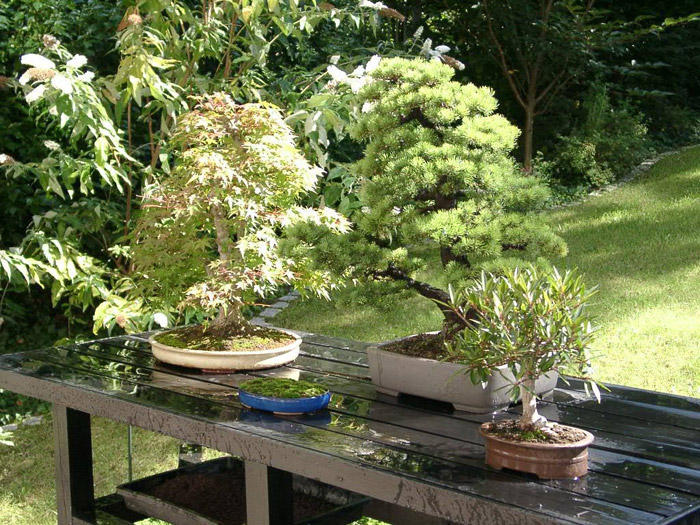
Now the sun is shining again. Here’s a tip on watering and where to place it: A fan maple can also be placed in full sun, but make sure it is watered optimally. It must be watered at the time when it needs the most water, and you can also water the planting area, which leads to higher humidity. An optimally watered and fertilized maple will not suffer sun damage. (Rather dry damage!)
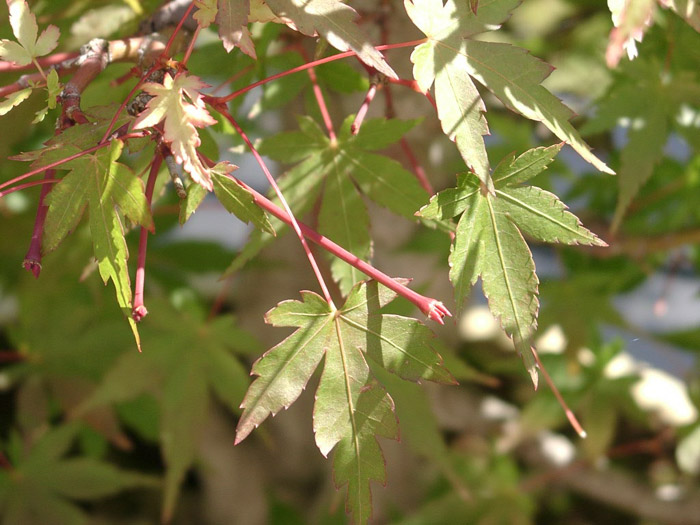
But now to the leaf pruning: strong buds have appeared in the relevant places, but whether they will still sprout is questionable. Looking back, the leaf pruning was probably done too late due to the bad weather. But that doesn’t matter, at worst we’ll have to postpone improving the branch structure until next year.
Autumn fertilization 13.09.2000
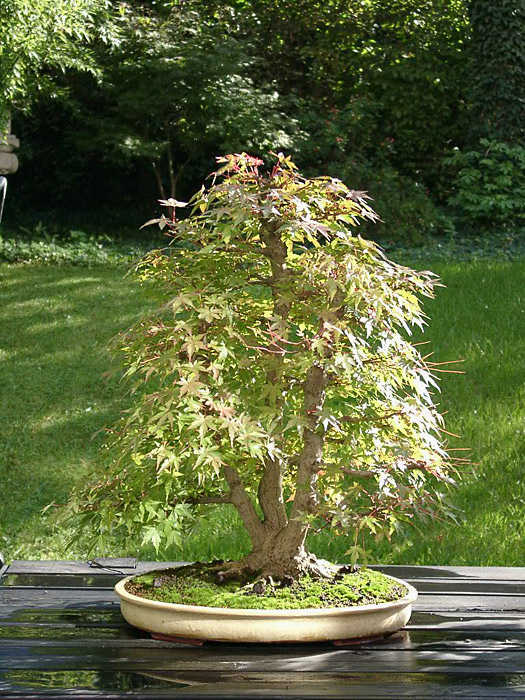
Autumn can no longer be held back. We have been fertilizing again for 2 weeks, this autumn fertilization is at least as important as the one in spring. The preparation should be P-K-emphasized so that the shoots of the year can harden and numerous new buds can develop. (Nitrogen stimulates too much new growth in length.) However, we use BioGold, which has also proved its worth in the fall and is available everywhere in specialist shops. Autumn coloration will then soon appear.
Autumn coloring 13.10.2008
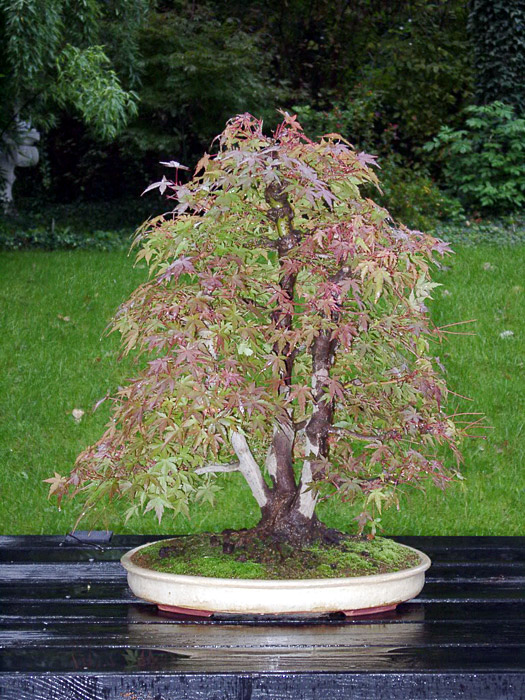
Now the fall colors begin. Unfortunately, we can hardly enjoy the beauty during these rainy days. We wait patiently for better days…
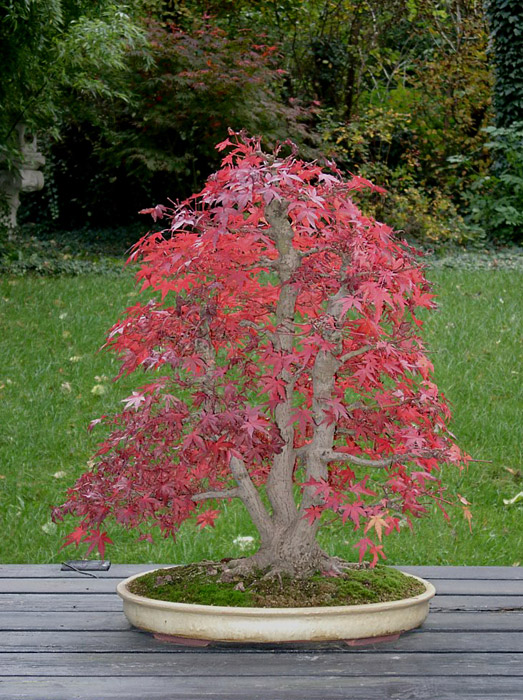
The maple impresses with its intense red color. The predicted autumn storms in Münsterland will not give us many days to enjoy the view.
Winter preparation 21.11.2000
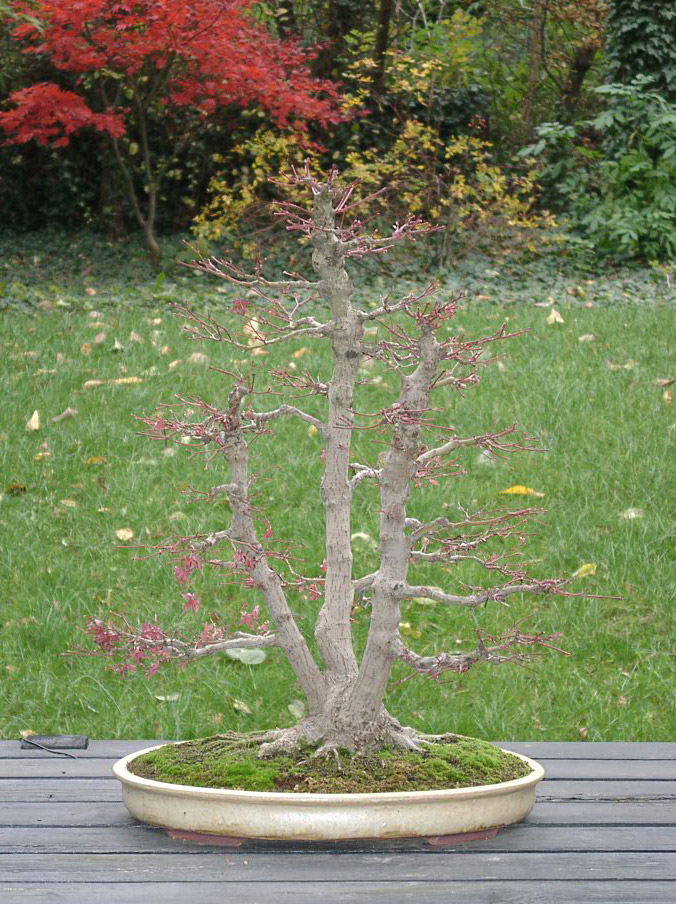
The windy, cold days have quickly stripped the tree of almost every last leaf. The temperatures are still very moderate and winter storage is not yet necessary. Unfortunately, it is raining so much that the root ball can no longer dry out. So I decided to protect the tree from the rain.
Now is also the time to carry out a preventive spraying against pests. The Japanese use Jinmittel, diluted 1:20. The soil should be covered and the rest sprayed once wet. The smell is quite unpleasant, but it reminds me of the nurseries in Japan.
Winter camp
27.11.2000
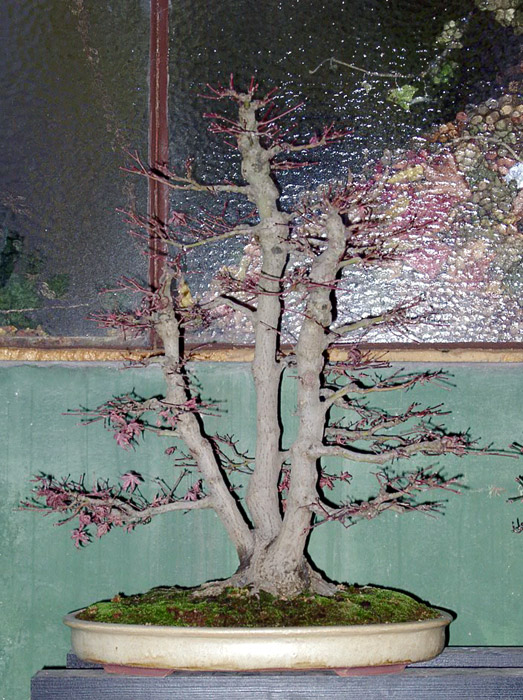
The tree has moved into its winter storage. It is an unheated, open conservatory. It can withstand a few degrees of frost. The room is only closed in the event of hard permafrost. If the bale is frozen through for too long, it can dry out. That’s why I occasionally try to gently raise the temperature so that the roots can draw water into the crown.
You have now been able to follow the maple throughout the year. Not much will happen in the next few weeks, not until the new year.