
The principle of bonsai (or suiseki) is based on the phenomenon that, even in nature, we only see trees in their entirety when we are far enough away to be able to see them from our perspective.
The special thing about bonsai is that, despite the apparent distance, details such as foliage, bark, flowers, fruit and fine branches are recognizable at the same moment. The trunk and the general shape (silhouette) and these details create a dual perspective (far – near). Bonsai is therefore always both: a distant illusion and the near reality of a tree. Bonsai has a dual character, which is also reflected in linguistic usage in such a way that bonsai are usually referred to as “trees”. The far-near problem is a problem of proportion. It becomes particularly clear in the Ishitsuki style, for example, because the “small tree” turns a small stone into a large rock or even a mountain.
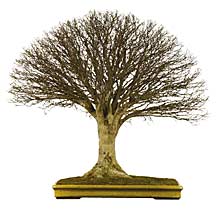
Introduction of the term “bonsai effect“
By bonsai effect I mean that bonsai and its presentation make use of the uncertainty of perception (i.e. the uncertain human position in the world). For all our perceptions, we need references, i.e. standards to which we can refer. If we do not have a familiar object (e.g. a house) as a reference for the size of a tree in a large meadow, for example, it is impossible to estimate the actual size of the tree. For what we see up close, our own body is usually the reference.
(At exhibitions it can be observed time and again that visitors touch the bonsai. In my opinion, this physical approach helps to clarify the proportions).
Construction and truth in bonsai
The design must be so meaningful and compelling in its construction, i.e. true, that it surpasses the objective truth (it is only a small plant) in its plausibility. The viewer then not only sees the plant itself, but places it in relation to his inner tree images. Since the latter has a higher or lower level of critical faculty, the average person, whose inner image of a tree is usually simple, is satisfied with the Chinese import with its coarsely gridded elements (trunk, crown). For more sophisticated contemporaries, however, only a work of the quality of Kimura’s work, for example, will suffice.
Differentiation of styles
The design of bonsai has different focuses depending on the style. In single-stemmed forms, the trunk plays the central role. It can hardly be changed in the design process (if one defines this term rather narrowly). The scope for design essentially relates to the branches, which are adapted to the trunk form, i.e. which are shaped and aligned according to the “natural” form of the trunk. The more trunks a style requires, the more these trunks become branches in the formal sense. Their alignment and positioning in relation to each other is carried out according to branch construction criteria. A raft form is the most striking example of this, because in it branches actually become trunks. But even in the forest form, the trunks in the flat bowl are aligned like branches on a horizontal, half-tree. The branch design is therefore of decisive importance in the direct design intervention.
Maturity
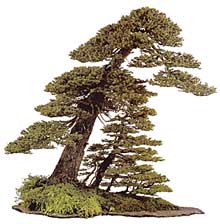
Maturity is an overarching concept in bonsai. The more mature a tree appears, the more bonsai it is. Maturity can only arise through years of development processes (refinement phase). Central ciphers for maturity, which can already be contained in the material, are, for example, movement (tight radii, breaks), integrated wounds (Jin, Shari, Saba-miki), signs of age (bark, color, low growth), strong yet harmonious tapering (thick trunk – low height) and harmonious transitions (V-shaped lines). All design steps are aimed at producing these maturity characteristics in a shorter time than the natural process. Wabi (plainness, simplicity, poverty, sparseness, reduction) and Sabi (dignity, maturity, usedness, patina) are important concepts in this context.
Naturalness
Contrary to expectations, bonsai are purely artificial products. They are not images of trees, not miniaturized symbols of nature, but bonsai are living plant elements in the art world, a promise of the existence of natural beauty. Like all works of art, they are specifically codified natural beauty. Since a law of form has emerged in bonsai, an autonomous bonsai code has developed in Japan in parallel with the development of art in the West. In its avant-garde expressions, the further development of this formal language is increasingly distancing itself from the forms borrowed from nature and is increasingly self-reflexively referring to its own history, above all through further developed technical possibilities. Naturalness thus becomes a second order: the beauty of nature is not simply reproduced, but created in the autonomous bonsai sphere.
Ecology
A concept that is inaccessible to classical aesthetics is that of ecological aesthetics. By definition, bonsai as a living plant only allows a limited manipulation of the natural material. The limit is tested anew in the immediate design process. If it is exceeded, a part or, in the worst case, the whole plant will die. Sculpture is also bound by natural limits (stability of the material). In the case of bonsai, however, it is not just a matter of considering the given physical properties of a material, otherwise the work would be spoiled. A wide range of experiences must be made with the stress possibilities of living matter and time processes must be respected. The designer is part of the design and the design determines the designer. The fact that a bonsai only bears this name as long as it is alive means that life takes precedence over all artistic considerations. This means that mastery of nature is subordinate to survival. The creative process is not only dependent on the will of the subject, but also on the possibilities of the material. This relativizes the idea of an autonomous sphere, not in relation to human intervention, but in its location in the natural process. Technology works on the boundary between culture and nature and strives to expand the autonomous sphere.